
Home |
Temáticas |
Catálogos |
Pedidos |
| |
|||||||
|

|
RUGENDAS. (Johann Moritz) HABITANTE DE GOYAS, QUADRO A ÓLEO PINTADO SOBRE MADEIRA. |
|
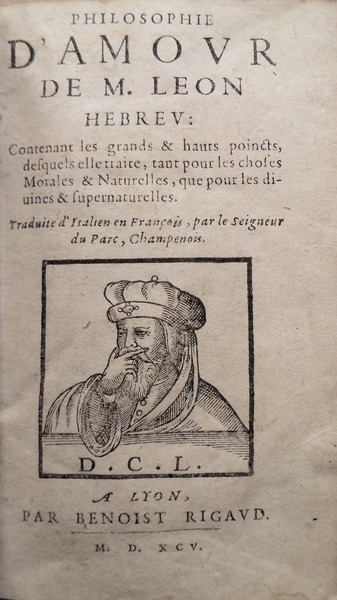
Clique nas imagens para aumentar. LEO HEBREW. [Judá Abravanel] PHILOSOPHIE D’ AMOUR DE M. LEON HEBREU:Contenant les grands & hauts poincts, desquels elle traite, tant pour les choses Morales & Naturelles, que pour les diuines & supernatureles. Traduite d’Italien en François, par le Seigneur du Parc, Champenois. A LYON, PAR BENOIST RIGAUD. M. D. XCV. [1595]. In 8º. 12x8 cm. 816, [47] págs. Encadernação em pergaminho flexível do século XVIII, com título 2 vezes manuscrito na lombada (uma vez ao alto e desvanecido e outra vez na coifa superior). Ilustrado com uma vinheta tipográfica com o retrato do autor no centro da folha de rosto. Reedição da versão original em francês traduzida por Denis Sauvage (Sieur du Parc) e impressa inicialmente por Guillaume Rouillé em 1551. Exemplar com leves picos de traça marginais sem afectar a leitura do texto. Principal obra deste autor, Diálogos de Amor, é um diálogo entre dois amantes: Fílon - o amor - e Sofia - a sabedoria. Aí expõe a sua doutrina, segundo a qual o amor é o fundamento ontológico do real, concebido não apenas como sentimental, mas também como intelectual. Deste modo pretende unificar fé e razão, embora deixando clara a prevalência da primeira. Pelo amor Deus criou e pelo amor a criatura regressa a Deus. É, então, o amor que a tudo anima e a tudo harmoniza. Neste sentido, Leão Hebreu defende uma conceção cosmológica que, à maneira neoplatónica, estabelece uma hierarquia de seres que vai do puro espírito - Deus - à matéria. O mundo é visto como um ser vivo composto de superior e inferior, respetivamente, alma e corpo. O regresso do homem a Deus realiza-se pelo amor na medida em que este é um amor intelectual. Esta visão idealizada e mística do amor exerceu um impacto profundo na literatura ocidental, servindo de base direta para a poesia lírica de Luís de Camões e influenciando profundamente autores como Miguel de Cervantes e Baruch Espinoza. A expressão Leão Hebreu refere-se a Judá Abravanel (Lisboa, c. 1460 – Nápoles, c. 1530), um influente filósofo, médico e poeta judeu sefardita português. O termo também pode estar relacionado à tradução da palavra leão para o hebraico Aryeh ou ao símbolo bíblico do 'Leão da Tribo de Judá”. Filho do célebre estadista, teólogo e financeiro Isaac Abravanel, Judá recebeu uma educação excecional que aliou a tradição talmúdica e a Cabala aos estudos de medicina, astrologia e filosofia clássica. A sua vida foi profundamente marcada pela instabilidade geopolítica da época: em 1483, a sua família foi forçada a fugir para o Reino de Castela devido a tensões políticas com o rei D. João II de Portugal. Anos mais tarde, em 1492, o Decreto de Alhambra promulgado pelos Reis Católicos obrigou-os a um novo exílio, desta vez para a península itálica, onde Judá enfrentou a dolorosa perda do seu filho primogénito, raptado e batizado à força por ordem real. Estabelecido em Itália, Judá Abravanel viveu em cidades como Nápoles, Génova e Veneza, onde exerceu a medicina com grande prestígio, chegando a servir como médico pessoal do capitão espanhol Gonzalo Fernández de Córdoba. Foi neste ambiente vibrante do humanismo italiano que conviveu com importantes intelectuais da época e redigiu, por volta de 1502, a sua obra-prima, os Diálogos de Amor (publicados postumamente em 1535). O filósofo faleceu em Nápoles por volta de 1530, deixando um legado intelectual duradouro que fundiu a mística judaica com o neoplatonismo cristão, quebrando barreiras religiosas e moldando o pensamento de grandes vultos da cultura ocidental.
18th-century flexible parchment binding, with the title handwritten twice on the spine (once at the top, where it has faded, and once on the upper cap). Illustrated with a typographic vignette featuring the author’s portrait in the centre of the title page. A reprint of the original French version, translated by Denis Sauvage (Sieur du Parc) and first printed by Guillaume Rouillé in 1551. Copy with slight marginal moth work that does not affect the readability of the text. This author’s main work, Diálogos de Amor (Dialogues on Love), is a dialogue between two lovers: Philo – love – and Sophia – wisdom. In it, he sets out his doctrine, according to which love is the ontological foundation of reality, conceived not only as emotional but also as intellectual. In this way, he seeks to unify faith and reason, whilst making clear the primacy of the former. Through love, God created, and through love, the creature returns to God. It is, therefore, love that animates and harmonises all things. Leo the Hebrew advocates a cosmological conception which, in the Neoplatonic manner, establishes a hierarchy of beings ranging from pure spirit – God – to matter. The world is viewed as a living being composed of a higher and a lower part, namely the soul and the body. Man’s return to God is achieved through love, insofar as this is an intellectual love. This idealised and mystical vision of love had a profound impact on Western literature, serving as a direct basis for the lyric poetry of Luís de Camões and profoundly influencing authors such as Miguel de Cervantes and Baruch Spinoza. The term ‘Hebrew Lion’ refers to Judah Abravanel (Lisbon, c. 1460 – Naples, c. 1530), an influential Portuguese Sephardic Jewish philosopher, physician and poet. The term may also be related to the Hebrew translation of the word ‘lion’ Aryeh or to the biblical symbol of the ‘Lion of the Tribe of Judah’. The son of the celebrated statesman, theologian and financier Isaac Abravanel, Judah received an exceptional education that combined Talmudic tradition and Kabbalah with studies in medicine, astrology and classical philosophy. His life was profoundly shaped by the geopolitical instability of the time: in 1483, his family was forced to flee to the Kingdom of Castile due to political tensions with King John II of Portugal. Years later, in 1492, the Decree of the Alhambra, issued by the Catholic Monarchs, forced them into a new exile, this time to the Italian peninsula, where Judah faced the painful loss of his eldest son, who was abducted and forcibly baptised by royal decree. Having settled in Italy, Judah Abravanel lived in cities such as Naples, Genoa and Venice, where he practised medicine with great distinction, even serving as personal physician to the Spanish captain Gonzalo Fernández de Córdoba. It was within this vibrant milieu of Italian humanism that he rubbed shoulders with leading intellectuals of the time and, around 1502, penned his masterpiece, the Dialogues on Love (published posthumously in 1535). The philosopher died in Naples around 1530, leaving behind an enduring intellectual legacy that fused Jewish mysticism with Christian Neoplatonism, breaking down religious barriers and shaping the thinking of major figures in Western culture. Ref:. Referência: 1502JC008
Local: SACO NMANNO1-01 Caixa de sugestões A sua opinião é importante para nós. Se encontrou um preço incorrecto, um erro ou um problema técnico nesta página, por favor avise-nos. 
Outras Sugestões
|
Pesquisa Simples




|
|||||||
 |
||||||||
|
 English
 In octavo. 12 × 8 cm. 816, [47] pp.