

Home |
Temáticas |
Catálogos |
Pedidos |
| |
|||||||
|

|
RUGENDAS. (Johann Moritz) HABITANTE DE GOYAS, QUADRO A ÓLEO PINTADO SOBRE MADEIRA. |
|
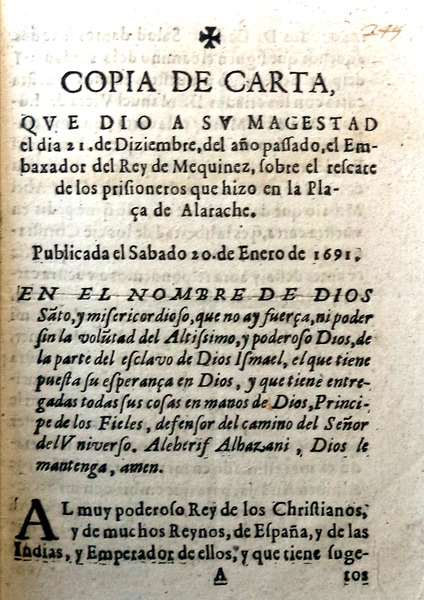
Clique nas imagens para aumentar. COPIA DE CARTA QVE DIO A SV MAGESTAD el dia 21. De Diziembre, del año passado, el Embaxador del Rey de Mequinez,sobre el rescate de los prisioneiros que hizo en la Plaça de Alarache. Publicada el Sabado 20. de Enero de 1691. COM PRIVILEGIO. EN MADRID: Por Sebastian de Armendariz, Librero de Camara de su Magestad, y Curial de Roma. En la Imprenta de ANTONIO ROMAN. In 4º de 20x14,3 cm. com 3, [i] folhas. Encadernado em cartonagem de papel de fantasia. Na carta transcrita, incluindo envio e o sobrescrito, o rei mouro estabelece as condições para libertar os 100 cristãos que aprisionou aquando da conquista da Praça de Larache, em 1689. Pelo resgate dos cem cristãos capturados em Larache, pede por 50 deles, cinco mil livros árabes manuscritos, cem por cada cristão, dos que estavam nas livrarias de Sevilha, Cordova e Granada e outros lugares, conquistados aos árabes, em 1236, Córdova, 1248, Sevilha e, em 1492, Granada, tendo sido os respectivos habitantes expulsos por decreto de 9 de Abril de 1609. Os livros manuscritos teriam que ser aprovados pelo secretário do rei. Pelos outros 50 cristãos pede 500 mouros, 10 por cada um. Se não se encontrarem os livros exige a entrega dos mouros que estão nas galeras e outras partes, quer sejam, mulheres, crianças, adultos ou velhos. Enquanto não for despachado tudo isto os 100 cristãos ficarão com os outros escravos. As trocas serão feitas em Ceuta. Este folheto inclui também a notícia da nomeação do Marquês de Leganés para Governador de Milão, as condições de aquisição das gazetas publicadas em Madrid com notícias da Europa e uma lista de livros à venda no mesmo local onde se vendem as gazetas. Folheto raríssimo e muito procurado. Não existem exemplares em bibliotecas nacionais. O Catalogo Colectivo del Patrimonio Bibliografico Español, só regista dois exemplares desta obra em todas as bibliotecas de Espanha, no Palacio Real em Madrid e na Biblioteca Municipal Serrano Morales de Valencia. Da edição do mesmo ano publicada em Zaragoza, só existe um exemplar na Abadia Benedita de Silos, em Burgos. Palau (1991) não regista este folheto. Fonte de grande importância para a história do domínio de países europeus no norte de África e para o estudo do desenvolvimento da imprensa escrita, (pois estes folhetos documentam um dos seus aspectos mais importantes) assim como pelo inusitado tipo de valores a entregar pela libertação dos cativos cristãos. Também é importante para o estudo das constantes guerras no Norte de África que levavam à captura de muitos prisioneiros de ambos os lados que precisavam de ser resgatados para não serem vendidos como escravos. Larache foi fundada np sèculo VIII. Entre 1471 e 1486 esteve abandonada devido à pressão da presença portuguesa em Arzila. Nesse último ano foi fortificada por Muley Naser, irmão do Rei de Fez. As fortificações foram reforçadas em 1578 por Muley Ahmed Dehebí. Em 1610, o seu filho, Muley Xej cedeu a praça ao Rei de Espanha. Por fim voltou à posse dos mouros depois de um cerco de três meses e meio, em 1689. Segundo os historiadores muçulmanos, uma cenetena de soldados foi trocada por mil mouros, pelo Acordo de Madrid de 17 de Janeiro de 1691, tendo os restantes prisioneiros espanhóis sido usados na construção dos jardins do Sultão em Mequinez, parece por isso que os espanhóis não devolveram os livros manuscritos, por não os terem ou não quererem. "Mequinez" (Meknés) durante este período, era a capital de Marrocos sob o reinado do Sultão Moulay Ismaïl, o mais célebre dos sultões alauitas, que governou Marrocos durante 55 anos, entre 1672 e 1727, e que manteve intensas relações diplomáticas, trocas de cativos e conflitos com as potências europeias.
In the transcribed letter, including the cover letter and the envelope, the Moorish king sets out the conditions for the release of the 100 Christians he imprisoned during the conquest of Larache. In exchange for the release of the one hundred Christians captured in Larache, he demanded, for fifty of them, five thousand handwritten Arabic books – one hundred for each Christian – from the libraries of Seville, Córdoba and Granada, and other places conquered from the Arabs in 1236, Córdoba in 1248, Seville and, in 1492, Granada, the inhabitants of these cities having been expelled by decree of 9 April 1609. The manuscript books would have to be approved by the king’s secretary. For the remaining 50 Christians, he demands 500 Moors, 10 for each one. If the books are not found, he demands the handover of the Moors who are in the galleys and elsewhere, whether they be women, children, adults or the elderly. Until all this has been sorted out, the 100 Christians will remain with the other slaves. The exchanges will take place in Ceuta. This leaflet also includes news of the appointment of the Marquis of Leganés as Governor of Milan, the terms and conditions for purchasing the gazettes published in Madrid containing news from Europe, and a list of books for sale at the same location where the gazettes are sold. An extremely rare and highly sought-after pamphlet. There are no copies in national libraries. The Collective Catalogue of Spanish Bibliographic Heritage lists only two copies of this work in all the libraries in Spain: one at the Royal Palace in Madrid and one at the Serrano Morales Municipal Library in Valencia. Of the edition published in Zaragoza in the same year, there is only one copy at the Benedictine Abbey of Silos in Burgos. Palau (1991) does not list this pamphlet. A source of great importance for the history of European rule in North Africa and for the study of the development of the printed press (as these leaflets document one of its most significant aspects), as well as for the unusual nature of the ransoms demanded for the release of Christian captives. It is also important for the study of the constant wars in North Africa, which led to the capture of many prisoners on both sides who needed to be ransomed to prevent them from being sold into slavery. Larache was founded in the 8th century. Between 1471 and 1486, it was abandoned due to pressure from the Portuguese presence in Arzila. In 1486, it was fortified by Muley Naser, brother of the King of Fez. The fortifications were reinforced in 1578 by Muley Ahmed Dehebí. In 1610, his son, Muley Xej, ceded the town to the King of Spain. It finally returned to Moorish hands after a siege lasting three and a half months in 1689. According to Muslim historians, a hundred soldiers were exchanged for a thousand Moors under the Treaty of Madrid of 17 January 1691, whilst the remaining Spanish prisoners were put to work building the Sultan’s gardens in Meknes; it would therefore appear that the Spanish did not return the manuscript books, either because they did not have them or because they did not wish to. During this period, ‘Mequinez’ (Meknès) was the capital of Morocco under the reign of Sultan Moulay Ismaïl, the most famous of the Alawite sultans, who ruled Morocco for 55 years, between 1672 and 1727, and who maintained intense diplomatic relations, prisoner exchanges and conflicts with the European powers. Referências/References: Referência: 1703PG109
Local: M-9-F-35 Indisponível Caixa de sugestões A sua opinião é importante para nós. Se encontrou um preço incorrecto, um erro ou um problema técnico nesta página, por favor avise-nos. 
Outras Sugestões
|
Pesquisa Simples




|
|||||||
 |
||||||||
|
 English
 In quarto. 20 × 14.3 cm. 3, [i] leaves. Bound in hardback cover made of phantasy paper.