

Home |
Temáticas |
Catálogos |
Pedidos |
| |
|||||||
|

|
RUGENDAS. (Johann Moritz) HABITANTE DE GOYAS, QUADRO A ÓLEO PINTADO SOBRE MADEIRA. |
|
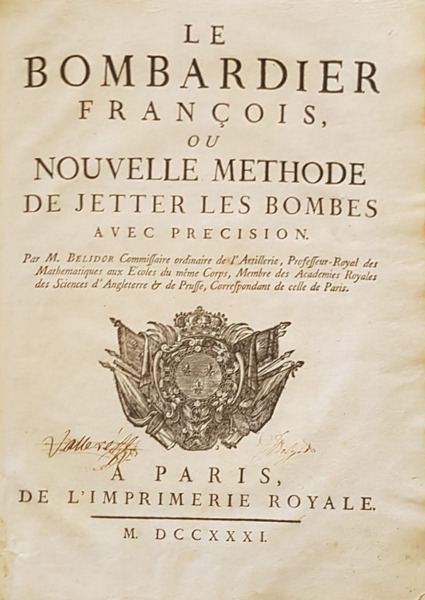
Clique nas imagens para aumentar. FOREST DE BELIDOR. (Bernard) LE BOMBARDIER FRANÇOIS, OU NOUVELLE METHODE DE JETTER LES BOMBES AVEC PRECISION.Par M. Belidor Commissaire ordinaire de l"Artillerie, Professeur-Royal des Mathematiques Aux Écoles du même Corps, Membre des Academies Royales des Sciences d"Angletterre & de Prusse, Correspondant de celle de Paris. A PARIS, DE L" IMPRIMERIE ROYALE. M. DCCXXXI. [1743]. In 4º de 20x26 cm com [vi], xli, [iii], 366 págs. Encadernação da época inteira de pele com nervos, ferros a ouro e rótulo vermelho na lombada. Folhas de guarda em papel marmoreado da época. Cortes de folhas carminados. Obra ilustrada em extratexto com uma magnífica gravura em frontispício antes da folha de rosto, representando um bombardeamento naval e terrestre durante um cerco a uma cidade portuária, assinada J. Rigaud i. Ss., e com 8 gravuras, em folhas desdobráveis, com artefactos de artilharia no final do volume, assinadas Simonneau Sculp. Apresenta tabelas no texto com grande número de quadros com as elevações dos morteiros necessárias para lançar obuses a diversas distâncias. Impressão muito nítida sobre papel de linho muito encorpado, em caracteres redondos, com alguns itálicos nos títulos dos capítulos e dos quadros e com um estandarte de guerra real francês alusivo no centro da folha de rosto. Exemplar com duas assinaturas de posse coevas na folha de rosto Vallerès[?] e JDelgado, com a primeira rasurada. Apresenta leves vestígios de trabalho de traça na folha de guarda anterior e na margem do frontispício gravado, algumas folhas um pouco acastanhadas por leve acidez do papel e pequenas e pontuais manchas de humidade nos cantos inferiores. 1ª Edição rara e procurada. Foi publicada 2ª edição em 1734. Le Bombardier François estabelece as bases científicas da artilharia moderna ao substituir o empirismo tradicional por rigorosos cálculos matemáticos e geométricos. A obra funciona como um manual técnico exaustivo que ensina a projetar bombas com precisão milimétrica, detalhando a influência das cargas de pólvora, os ângulos de inclinação dos morteiros e a trajetória parabólica dos projéteis. Através de tabelas balísticas inovadoras e ilustrações detalhadas, Bélidor transformou o bombardeio de cercos numa disciplina de engenharia, permitindo que os oficiais planeassem ataques mais eficazes, económicos e previsíveis contra fortificações inimigas. Bernard Forest de Bélidor (1698–1761) foi um influente engenheiro militar e matemático francês que desempenhou um papel crucial na transição da engenharia de um ofício prático para uma disciplina científica. Nascido na Catalunha e criado num ambiente militar, tornou-se professor na Escola de Artilharia de La Fère aos 22 anos, onde começou a aplicar princípios matemáticos rigorosos à balística e à hidráulica. Autor de tratados seminais como Le Bombardier François e Architecture Hydraulique, Bélidor revolucionou o uso da artilharia em cercos e o design de infraestruturas civis, sendo hoje amplamente reconhecido como o pai da engenharia moderna e um dos principais intelectuais técnicos do século XVIII. JUNTO COM MANUSCRITO: LIPPE. (Conde Reinante de Schaumbourg) MEMOIRE CONTENANT QUELQUES CONNAISSANCES INDISPENSABLEMENT NECESSAIRES POUR POINTER LE CANON. À la Portée du simple canonier. Buckebourg. 1769. De 23,3x18,9 cm. Com 7, [i em br.] págs. Manual para apontadores de canhões, com perguntas e respostas, elaborado por Ordem do Conde de Lippe, contendo na página 2 uma introdução da sua autoria. Wilhelm Friedrich Ernst zu Schaumburg-Lippe (1724–1777), conhecido em Portugal como o Conde de Lippe, foi um dos mais brilhantes estrategas militares do século XVIII e uma figura central na modernização do exército português. Nascido na Alemanha e educado sob ideais iluministas, destacou-se inicialmente ao serviço da Grã-Bretanha e de Hanôver antes de ser convidado pelo Marquês de Pombal para reorganizar as forças de Portugal durante a Guerra de 1762. Além de fundar escolas militares e introduzir táticas de defesa inovadoras (exemplificadas pela construção do Forte de Nossa Senhora da Graça em Elvas), Lippe foi um pioneiro na defesa da ética militar e da disciplina, deixando um legado duradouro que profissionalizou a estrutura das forças armadas portuguesas.
Binding: Contemporary full calf with raised bands, red label and gilt tools on spine. Endpapers in contemporary marbled decorative paper. Red edges. Work illustrated hors-text with a magnificent engraving before the title page, depicting a naval and land bombardment to a port city, signed J. Rigaud i. Ss.; and with 8 folded engravings at the end of the volume depicting artillery artefacts signed Simonneau Sculp. In text it has a large number of tables with elevation of the mortars needed to launch the shells at several distances. A very sharp print on thick linen paper with round characters and italic characters on the titles of the chapters and tables. In the centre of the title page there is a the French royal war flag. Copy with two contemporary ownership signatures "Vallerès[?] and JDelgado, being the first one scratched. It has slight wormholes on the glued endpaper and at the margin of the engraved frontispiece; some pages are slightly brown due to paper acidity; small foxing at the bottom corners of pages. First edition, very rare and sought after. There was a second edition in 1734. Le Bombardier François lays the scientific foundations of modern artillery by replacing traditional empiricism with rigorous mathematical and geometric calculations. The work serves as a comprehensive technical manual teaching how to design bombs with millimetre precision, detailing the influence of gunpowder charges, the angles of inclination of mortars and the parabolic trajectory of projectiles. Through innovative ballistic tables and detailed illustrations, Bélidor transformed the bombardment of sieges into an engineering discipline, enabling officers to plan more effective, economical and predictable attacks against enemy fortifications. Bernard Forest de Bélidor (1698–1761) was an influential French military engineer and mathematician who played a crucial role in the transition of engineering from a practical craft to a scientific discipline. Born in Catalonia and raised in a military environment, he became a professor at the Artillery School of La Fère at the age of 22, where he began applying rigorous mathematical principles to ballistics and hydraulics. Author of seminal treatises such as Le Bombardier François and Architecture Hydraulique, Bélidor revolutionised the use of artillery in sieges and the design of civil infrastructure, and is today widely recognised as the father of modern engineering and one of the leading technical intellectuals of the 18th century. TOGETHER WITH A MANUSCRIPT: LIPPE. (Reigning Count of Schaumbourg) MEMOIRE CONTENANT QUELQUES CONNAISSANCES INDISPENSABLEMENT NECESSAIRES POUR POINTER LE CANON. À la Portée du simple canonier. Buckebourg. 1769. Dim.: 23.3x18.9 cm with 7, [i blank.] pp. Manual for the crews operating canons, with questions and answers, ordered by the Count of Lippe, who wrote the introduction on page 2. Wilhelm Friedrich Ernst zu Schaumburg-Lippe (1724–1777), known in Portugal as the Count of Lippe, was one of the most brilliant military strategists of the 18th century and a central figure in the modernisation of the Portuguese army. Born in Germany and educated in the ideals of the Enlightenment, he initially distinguished himself in the service of Great Britain and Hanover before being invited by the Marquis of Pombal to reorganise Portugal’s forces during the War of 1762. In addition to founding military schools and introducing innovative defence tactics (exemplified by the construction of the Fort of Nossa Senhora da Graça in Elvas), Lippe was a pioneer in the defence of military ethics and discipline, leaving a lasting legacy that professionalised the structure of the Portuguese armed forces. Referência: 2003PG004
Local: M-17-B-22 Caixa de sugestões A sua opinião é importante para nós. Se encontrou um preço incorrecto, um erro ou um problema técnico nesta página, por favor avise-nos. 
Outras Sugestões
|
Pesquisa Simples




|
|||||||
 |
||||||||
|
 English
 Dim.: In 4º (20x26 cm) with [vi], xli, [iii], 366 pp.