
Home |
Temáticas |
Catálogos |
Pedidos |
| |
|||||||
|

|
RUGENDAS. (Johann Moritz) HABITANTE DE GOYAS, QUADRO A ÓLEO PINTADO SOBRE MADEIRA. |
|

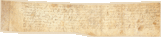
Clique nas imagens para aumentar. MANUSCRITO - SIGILOGRAFIA - SÉCULO XVIII - CARTA DE CONFIRMAÇÃO DE D. MARIA I, PELA QUAL FAZ MERCÊ AOS VEREADORES E MAIS OFICIAIS DA POVOA DE MONTE REALDe lhe confirmar o Privilegio que o Senhor Rey Dom Dinis lhe concedeo, e foi ultimamente confirmado, pelo Senhor Rey Dom João o quinto. Dada na Cidade de Lisboa aos dezassete dias do mez d" Agosto Joaquim José da Motta Cerveira a fez. Anno do Nascimento de Nosso Senhor Jesus Christo de mil sete centos noventa e tres annos. O Principe [17 de Agosto de 1793]. Manuscrito de 37,8x27 cm. Com 8 fólios de pergaminho, ou seja 4 folhas dobradas em bifólios e cosidas nas dobras. Texto com 28 linhas por página em letra nítida e elegante. Assinada pelo Príncipe D. João em nome da Rainha D. Maria e com o respectivo selo pendente de chumbo (4,1x4,5 cm) seguro por cordão, que passa por dois buracos na parte inferior da dobra dos fólios, com as armas reais de D. Maria I, nos dois lados e com a inscrição: Maria I D.[ei] G.[ratia] Portug[aliae] et Algarbiorum Regina. Apresenta algum desgaste de manuseamento na frente do primeiro fólio, sem impedir a leitura, e nas margens de alguns dos fólios, manchas de tinta da época, em especial nas duas últimas folhas e alguma ondulação e vincos característicos do pergaminho. O selo apresenta algum desgaste no verso onde a legenda fica quase apagada no lado esquerdo do selo. Transcreve o Alvará de 9 de Abril de 1793, com a resolução da Rainha de Março do mesmo ano, elaborado por Luís de Vasconcelos e Sousa e Frederico Ludovici, que concede a mercê e manda passar esta Carta de Confirmação. De seguida transcreve (fólio 1 verso a 6 frente) o Alvará e a respectiva Carta de confirmação de D. João V, datados de 5 de Abril e de 26 de Maio de 1710. Nela são por sua vez transcritas as cartas de confirmação de D. Pedro II, 30 de Abril de 1699 e depois sucessivamente as cartas de confirmação de D. Filipe I, de D. Duarte, D. João I e de D. Dinis. No fólio 6 frente é feita uma restrição aos direitos concedidos por D. Dinis, com a seguinte fórmula: «ficam somente confirmados aqueles de que os suplicantes se achão de posse». No fólio 7 frente estão inscritos os documentos relativos ao despacho da Mesa do Desembargo do Paço de 12 de Agosto de 1793; a certidão das quantias pagas de 24 de Setembro de 1793; a certidão do registo na Secretaria do Registo Geral das Mercês de 20 de Setembro de 1793; a certidão dos Registos na Chancelaria Mór da Corte e Reino de 25 de Setembro de 1793 e de 3 de Outubro de 1793; e no canto inferior tem a conta dos valores pagos. No verso do fólio 7 tem os registos na Cãmara de Leiria e na de 3 de Janeiro de 1794, 21 de Janeiro de 1794; e de 23 de Fevereiro de 1794. Finalmente no fólio 8 frente tem um pequeno averbamento com a data de 1808 e, no fólio 8 verso, tem o registo de ter sido depositado no Arquivo do Concelho em 1824 e 1825 e no canto inferior direito do mesmo fólio a cota P. 527. O fólio 1 frente tem à cabeça no canto direito o número e a página do livro onde esta carta foi registada: L.º 20 a p. 89. Documento muito importante que comprova os constantes esforços dos habitantes de Monte Real e das terras circundantes, ao longo do tempo, para garantirem a manutenção dos privilégios que lhes tinham sido concedidos pelo Rei D, Dinis, pelas cartas de foro de 1310 e 1312, e que tinham sido prejudicados pela decisão de D. Afonso V de doar a D. Pedro de Meneses, em 1463, os direitos e rendas do Campo de Ulmar, situação que se manteve até 1641. D. Maria I, (Lisboa 1734 - Rio de Janeiro 1816) foi rainha de Portugal de 1777 a 1816, mas desde 10 de Fevereiro de 1792 começou a mostrar acentuados sinais de problemas psíquicos e o seu filho, o Princípe D, João, começou a tratar dos negócios do Estado em nome da rainha e a partir de 1799 tornou-se regente do reino. É ele que assina a presente Carta de Confirmação durante o primeiro destes dois períodos. Monte Real, anteriormente designada por Vila da Póvoa de Monte Real, freguesia do distrito de Leiria, foi fundada, em 1292, pelo rei D. Dinis e deve o seu nome ao facto de ter existido um Paço Real do qual se conservam as ruínas restauradas, que eram, provavelmente, umas casas onde o Rei se estabelecia para supervisionar a plantação do Pinhal de Leiria e os trabalhos de enxugo dos campos do Ulmar, o que deu o nome à Vila - o Monte Real. Desde 1292 e até ao início do século XIX, foi sede de concelho e, em 1801, tinha 829 habitantes, com 4 localidades anexas: Serra de Porto Urso, Granja, Brejo e Segodim. A região foi gravemente afectada pela Terceira Invasão Francesa, tendo sido incendiados e destruídos grande número de edíficios e morta pelo menos metade da população. Por isso durante o século XIX a região perdeu muito da sua importância e em 1834 o Concelho de Monte Real foi anexado ao de Leiria. Actualmente a freguesia tem 2778 habitantes e possui uma estância termal que remontará à epoca romana e onde se atribui à Rainha Santa Isabel, mulher de D. Dinis a realização de curas milagrosas.
To confirm the Privilege that the Lord King Dom Dinis granted him, and was lately confirmed by the Lord King Dom João the fifth. Dated in the City of Lisbon on the seventeenth day of August. Joaquim José da Motta Cerveira made it. Year of the Birth of Our Lord Jesus Christ one thousand seven hundred ninety-three. The Prince [17 August 1793]. Manuscript of 37.8x27 cm. With 8 parchment folios, i.e. 4 leaves folded into bifolios and stitched at the folds. Text with 28 lines per page in crisp, elegant handwriting. Signed by Prince John on behalf of Queen Mary and with the respective lead pendant seal (4.1x4.5 cm) secured by cord, which passes through two holes at the bottom of the fold of the folios, with the royal arms of Queen Mary I on both sides and with the inscription: Maria I D.[ei] G.[ratia] Portug[aliae] et Algarbiorum Regina. It shows some signs of handling on the front of the first folio, without impeding reading, and on the margins of some of the folios, contemporary ink stains, especially on the last two leaves and some rippling and creasing characteristic of parchment. The seal shows some wear on the reverse where the legend is almost erased on the left side of the seal. Transcribes the Charter of 9 April 1793, with the Queen"s resolution of March of the same year, drawn up by Luís de Vasconcelos e Sousa and Frederico Ludovici, which grants the mercy and orders to pass this Letter of Confirmation. It then transcribes (folio 1 overleaf to 6 overleaf) the Charter and the respective Letter of Confirmation of King João V, dated 5 April and 26 May 1710. The letters of confirmation of Pedro II, 30 April 1699, are transcribed therein, followed by the letters of confirmation of Filipe I, Duarte, João I and Dinis. On folio 6 on the front, a restriction is made to the rights granted by King Dinis, with the following formula: 'only those of which the petitioners are in possession are confirmed'. In the front folio 7 there are the documents relative to the dispatch of the Board of the High Court of 12 August 1793; the certificate of the amounts paid of 24 September 1793; the certificate of the registry in the Secretaria do Registo Geral das Mercês of 20 September 1793; the certificate of the registries in the High Chancellery of Court and Kingdom of 25 September 1793 and 3 October 1793; and in the lower corner there is the account of the amounts paid. On the back of folio 7 there are the registers at the City Hall of Leiria and on 3 January 1794, 21 January 1794; and 23 February 1794. Finally on folio 8 front there is a small annotation with the date 1808 and folio 8 back has the record of having been deposited in the Council Archive in 1824 and 1825 and in the lower right corner of the same folio the quotation P. 527. Folio 1 front has at the top right corner the number and page of the book where this letter was recorded: L.º 20 a p. 89. Very important document that proves the constant efforts of the inhabitants of Monte Real and the surrounding lands, throughout time, to guarantee the maintenance of the privileges that had been granted to them by King D. Dinis, by the charter of 1310 and 1312, and that had been harmed by the decision of D. Afonso V to donate to D. Pedro de Meneses, in 1463, the rights and rents of Campo de Ulmar, a situation that continued until 1641. D. Maria I, (Lisbon 1734 - Rio de Janeiro 1816) was Queen of Portugal from 1777 to 1816, but from 10 February 1792 she began to show marked signs of psychic problems and her son, Prince João, began to handle the affairs of state on behalf of the Queen and from 1799 became regent of the kingdom. It is he who signs the present Letter of Confirmation during the first of these two periods. Monte Real, formerly known as Vila da Póvoa de Monte Real, a parish in the district of Leiria, was founded in 1292 by King Dinis and owes its name to the fact that there was a Royal Palace, of which the restored ruins are preserved, which were probably some houses where the King used to settle to supervise the planting of the Leiria Pine Forest and the hoeing of the fields of Ulmar, which gave the town its name - Monte Real. Referências/References: ALBERTO, Isidro da Piedade - Monte Real, terra histórica ontem e hoje. Edição da Região de Turismo de Leiria, 1991. Referência: 2209PG004
Local: Gravureiro Gav. 8-6 Indisponível Caixa de sugestões A sua opinião é importante para nós. Se encontrou um preço incorrecto, um erro ou um problema técnico nesta página, por favor avise-nos. 
Outras Sugestões
|
Pesquisa Simples




|
|||||||
 |
||||||||
|
 English
 MANUSCRIPT - SIGILLOGRAPHY – 18th. CENTURY - LETTER OF CONFIRMATION OF KING MARIA I, BY WHICH SHE GRANTS A FAVOUR TO THE TOWN COUNCILLORS AND OTHER OFFICIALS OF THE VILLAGE OF MONTE REAL