

Home |
Temáticas |
Catálogos |
Pedidos |
| |
|||||||
|

|
RUGENDAS. (Johann Moritz) HABITANTE DE GOYAS, QUADRO A ÓLEO PINTADO SOBRE MADEIRA. |
|
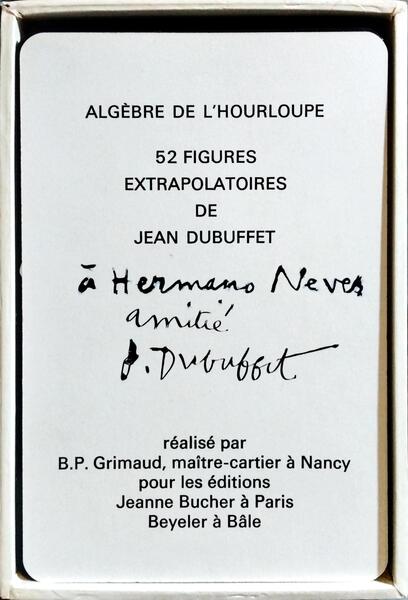
Clique nas imagens para aumentar. DUBUFFET. (Jean) ALGÈBRE DE L'HOURLOUPE.52 Figures Extrapolatoires de... Réalise par B.P. Grimaud, maitre-carier à Nancy pour les éditions. Jeanne Bucher à Paris. Beyeler à Bâle. [1968] De 19x13 cm. Com 54 serigrafias coloridas em cartolina, acondicionadas em caixa em cartão serigrafada do editor. Profusamente ilustrado com 52 serigrafias a cores do autor. Exemplar com dedicatória do autor ao jornalista português Hermano Neves, na cartolina onde consta o título da obra, e ligeiras falhas de revestimento na caixa de cartão do editor. Data segundo a BNF. Muito raro, 1.ª edição de uma tiragem limitada, segundo a BNF. Conjunto de 54 cartas serigráficas em cartão reproduzidas em 1968, das quais duas dedicadas ao título da obra, com 17x11 cm, inserida no ciclo artístico l’Hourloupe, onde cada carta representa uma figura única abstrata intitulada no verso. Este ciclo artístico iniciou em 1962, caracterizado por representação de formas orgânicas delineadas a preto, preenchidas com as cores primárias vermelho, azul e branco, evocando um universo imaginário ornírico. As cartas, tem um carácter lúdico, gráfico e conceptual com formas, que podem sugerir animais, pessoas ou máquinas, mas rapidamente se desconstroem, deixando espaço para múltiplas interpretações. O título Algèbre de l’Hourloupe é uma metáfora poética. A palavra “álgebra” refere-se a um sistema mental de símbolos, uma gramática visual do subconsciente. Procura representar a estrutura do pensamento não racional, como um mapa caótico e intuitivo da mente. O Ciclo L’Hourloupe (1962–1974), engloba: pinturas, desenhos, esculturas, ambientes imersivos (como o “Clube do Hourloupe”), obras monumentais como Coucou Bazar (uma “pintura animada” com formas móveis e música). Jean Philippe Arthur Dubuffet (Le Havre, 1901 – Paris, 1985), foi um pintor, escultor e gravurista francês, mais conhecido pelo desenvolvimento da art brut (arte bruta), termo criado em 1945 para designar a arte produzida por autodidatas livres de estilos oficiais. Pertenceu à primeira geração de artistas europeus do pós-II Guerra Mundial que presenciaram a destruição da velha ordem, assegurada por movimentos, ideologias, conteúdos e formas – algo chamado como o “crepúsculo do absoluto”.
Copy with dedication by the author to Portuguese journalist Hermano Neves on the title page, and slight damage to the publisher's cardboard box. Date according to the BNF. Very rare, first edition of a limited print run, according to the BNF. Set of 54 screen-printed cards on cardboard reproduced in 1968, two of which are dedicated to the title of the work, measuring 17x11 cm, included in the artistic cycle l'Hourloupe, where each card represents a unique abstract figure titled on the back. This artistic cycle began in 1962, characterised by the representation of organic forms outlined in black, filled with the primary colours red, blue and white, evoking an imaginary ornithological universe. The cards have a playful, graphic and conceptual character with shapes that may suggest animals, people or machines, but quickly deconstruct themselves, leaving room for multiple interpretations. The title Algèbre de l’Hourloupe is a poetic metaphor. The word 'algebra' refers to a mental system of symbols, a visual grammar of the subconscious. It seeks to represent the structure of non-rational thought, like a chaotic and intuitive map of the mind. The L’Hourloupe Cycle (1962–1974) encompasses paintings, drawings, sculptures, immersive environments (such as the Hourloupe Club), and monumental works such as Coucou Bazar (an “animated painting” with moving shapes and music). Jean Philippe Arthur Dubuffet (Le Havre, 1901 – Paris, 1985) was a French painter, sculptor and engraver, best known for developing art brut (raw art), a term coined in 1945 to describe art produced by self-taught artists free from official styles. He belonged to the first generation of post-World War II European artists who witnessed the destruction of the old order, brought about by movements, ideologies, content and forms – something called the 'twilight of the absolute'. Referências/References: Referência: 2502RS087
Local: M-14-C-27 Caixa de sugestões A sua opinião é importante para nós. Se encontrou um preço incorrecto, um erro ou um problema técnico nesta página, por favor avise-nos. 
Outras Sugestões
|
Pesquisa Simples




|
|||||||
 |
||||||||
|
 English
 19x13 cm. 54 colour silkscreen prints on cardoard, packed in a publisher’s silkscreen-printed cardboard box. Lavishly illustrated with 52 colour silkscreen prints by the author.