
Home |
Temáticas |
Catálogos |
Pedidos |
| |
|||||||
|

|
RUGENDAS. (Johann Moritz) HABITANTE DE GOYAS, QUADRO A ÓLEO PINTADO SOBRE MADEIRA. |
|
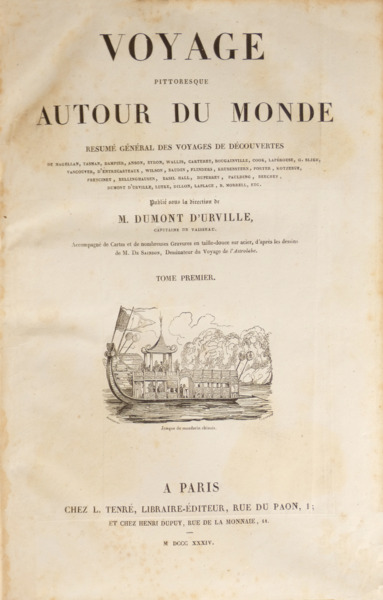
Clique nas imagens para aumentar. REYBAUD. (Louis) e Jules Sebastien Cesar Dumont d'Urville. VOYAGE PITTORESQUE AUTOUR DU MONDE.RÉSUMÉ GÉNÉRAL DES VOYAGES DE DÉCOUVERTES de Magellan, Tasman, Dampier, Anson, Byron, Wallis, Carteret, Bougainville, Cook, Lapérouse, G. Bligh, Vancouver, d'Entrecasteaux, Wilson, Baudin, Flinders, Krusenstern, Porter, Kotzebue, Freycinet, Bellinghausen, Basil Hall, Duperrey, Paulding, Beechey, Dumont d'Urville, Lutke, Dillon, Laplace, B. Morrell, etc. Publié sous la direction de M. DUMONT D'URVILLE, capitaine de vaisseau. Accompagné de cartes et de nombreuses gravures en taille-douce sur acier, d'après les dessins de M. de Sainson, dessinateur du voyage de l'Astrolabe. Tome premier. [Tome second]. A PARIS CHEZ L. TENRÉ, LIBRAIRE-ÉDITEUR, RUE DU PAON, 1; et chez Henri Dupuy, rue de la Monnaie, 11. M DCCC XXXIV. [1834]. 2 Volumes de 28,5x19,5 cm. Com [viii], viii, 576; [iv], 584 págs. Encadernações com lombadas em pele com belos ferros a ouro e pastas revestidas em papel lustroso verde. Folhas de guarda decorativas e cortes das folhas marmoreados com belo e detalhado padrão em tons de verde. Profusamente ilustrado com 278 gravuras em extratexto sobre papel couché, executadas em calcografia sobre aço a partir dos desenhos de Louis-Auguste de Sainson, desenhador oficial da expedição da corveta Astrolabe (1826-1829). Inclui 6 cartas desdobráveis gravadas por A. Tardieu: duas cartas gerais (uma do mundo e uma do Oceano Pacífico) e quatro cartas particulares dos arquipélagos do Hawai, Taiti, Tonga e Nova Zelândia. Estas gravuras constituem um testemunho visual inestimável dos povos, paisagens e costumes do Pacífico, com particular relevo para a Oceania. A iconografia inclui retratos etnográficos, vistas de paisagens, cenas de vida quotidiana e cerimónias, além de representações de fauna e flora, oferecendo um conjunto documental de valor histórico e artístico excepcional. Texto disposto em duas colunas, ornamentado com vinheta xilogravada representando uma embarcação chinesa na folha de rosto. Exemplar com a carta geral do mundo que antecede a introdução do primeiro volume rasgada e solta, com restauros amadores. Os rasgos não atingem a mancha tipográfica nem comprometem a leitura. As páginas 555 a 558 do segundo volume encontram-se soltas. Primeira edição rara desta síntese fundamental, publicada simultaneamente por L. Tenré e Henri Dupuy. A obra foi redigida em parte por Louis Reybaud e em parte por Dumont d'Urville, conforme indicado nos repertórios bibliográficos da época. Obra muito importante da literatura geográfica francesa do século XIX, constituindo uma síntese magistral dos grandes descobrimentos marítimos desde Fernão de Magalhães até às expedições contemporâneas. Representa o culminar da tradição francesa dos relatos de viagem científicos e populares, oferecendo ao público culto da época um panorama completo das explorações oceânicas através de uma narrativa fluida e pedagogicamente estruturada. A obra nasce da necessidade expressa na introdução de tornar acessível ao grande público as descobertas das grandes expedições científicas, cujas publicações oficiais, pelo seu luxo e custo elevado, permaneciam fora do alcance da generalidade dos leitores. Dumont d'Urville, apoiado na redação de Louis Reybaud, concebeu um formato inovador: um voyageur fictício — «sorte d'Anacharsis circum-navigateur» — que permite sintetizar as experiências de todos os grandes navegadores numa única circumnavegação, evitando assim as repetições fastidiosas e os dados náuticos excessivamente técnicos que caracterizavam as relações originais. O «Voyage Pittoresque» insere-se no contexto da popularização científica da primeira metade do século XIX, período em que a França procurava rivalizar com a Inglaterra no domínio das explorações oceânicas. A obra sintetiza os resultados das expedições de l'Uranie (Freycinet), la Coquille (Duperrey) e l'Astrolabe (Dumont d'Urville), as três grandes campanhas científicas francesas da Restauração, estabelecendo uma narrativa de conjunto que evidencia a contribuição francesa para o conhecimento geográfico mundial. A estrutura da obra segue uma lógica geográfica centrada no Oceano Pacífico, que Dumont d'Urville propõe dividir em quatro grandes regiões: Polinésia, Micronésia, Malásia e Melanésia — divisão etnográfica inovadora baseada nas características físicas e culturais dos povos, que influenciará duradouramente a geografia humana da Oceania. Esta sistematização, exposta na introdução, constitui uma das primeiras tentativas de classificação científica dos povos oceânicos segundo critérios antropológicos modernos. Jules-Sébastien-César Dumont d'Urville (Condé-sur-Noireau, 1790 – Meudon, 1842) foi um dos mais distintos exploradores franceses do século XIX, oficial de marinha que comandou duas expedições de circumnavegação científica a bordo de l'Astrolabe (1826-1829 e 1837-1840). Participou no processo da identificação e aquisição pela França da Vénus de Milo em 1820, determinou o local do naufrágio de La Pérouse em Vanikoro (1828) e explorou extensivamente a Antártida, dando o nome de Terra Adélia à região que descobriu em homenagem à sua esposa. Pereceu tragicamente com a família na catástrofe ferroviária de Meudon, uma das primeiras grandes catástrofes ferroviárias francesas. A sua obra científica, que compreende várias dezenas de volumes, constitui uma das contribuições mais importantes para o conhecimento geográfico e etnográfico do século XIX. Louis Reybaud (Marselha, 1799 – Paris, 1879) foi escritor, economista político e deputado, conhecido sobretudo pelos seus trabalhos sobre o socialismo utópico e pela sátira social «Jérôme Paturot à la recherche d'une position sociale» (1843). Colaborou na redação de importantes obras de vulgarização histórica e geográfica, incluindo a «Histoire scientifique et militaire de l'expédition française en Égypte» (1830-1836). A sua participação no «Voyage Pittoresque» enquadra-se no seu interesse pelas grandes sínteses divulgativas destinadas ao público cultivado da época. Louis-Auguste de Sainson (Paris, 1800 – Paris, 1874) foi desenhador e pintor especializado em história natural e geografia, celebrado pela sua participação como desenhador oficial da expedição de l'Astrolabe (1826-1829). Os seus desenhos, executados durante as diferentes escalas e posteriormente gravados, constituem um testemunho de valor inestimável sobre os povos e paisagens do Pacífico. Produziu cerca de 500 desenhos durante a expedição, dos quais uma parte considerável foi utilizada nas publicações oficiais da viagem e nesta síntese popular.
Profusely illustrated with 278 engravings on glossy paper, etched in steel from drawings by Louis-Auguste de Sainson, official draughtsman of the expedition of the corvette Astrolabe (1826-1829). It includes six fold-out maps engraved by A. Tardieu: two general maps (one of the world and one of the Pacific Ocean) and four specific maps of the archipelagos of Hawaii, Tahiti, Tonga and New Zealand. These engravings constitute an invaluable visual record of the peoples, landscapes and customs of the Pacific, with particular emphasis on Oceania. The iconography includes ethnographic portraits, landscape views, scenes of daily life and ceremonies, as well as representations of fauna and flora, offering a documentary collection of exceptional historical and artistic value. Text arranged in two columns, decorated with a woodcut vignette depicting a Chinese vessel on the title page. Copy with the general map of the world preceding the introduction to the first volume torn and loose, with amateur restorations. The tears do not affect the text area or compromise readability. Pages 555 to 558 of the second volume are loose. Rare first edition of this fundamental summary, published simultaneously by L. Tenré and Henri Dupuy. The work was written partly by Louis Reybaud and partly by Dumont d"Urville, as indicated in the bibliographic repertoires of the time. Very important work of 19th-century French geographical literature, constituting a masterful synthesis of the great maritime discoveries from Ferdinand Magellan to contemporary expeditions. It represents the culmination of the French tradition of scientific and popular travelogues, offering the educated public of the time a complete overview of oceanic explorations through a fluid and pedagogically structured narrative. The work stems from the need expressed in the introduction to make the discoveries of major scientific expeditions accessible to the general public, whose official publications, due to their luxury and high cost, remained out of reach for most readers. Dumont d"Urville, with the help of Louis Reybaud, devised an innovative format: a fictional voyageur — "sorte d"Anacharsis circum-navigateur" — who synthesises the experiences of all the great navigators in a single circumnavigation, thus avoiding the tedious repetitions and overly technical nautical data that characterised the original accounts. The Voyage Pittoresque was part of the scientific popularisation movement of the first half of the 19th century, a period when France sought to rival England in the field of ocean exploration. The work summarises the results of the expeditions of l"Uranie (Freycinet), la Coquille (Duperrey) and l"Astrolabe (Dumont d"Urville), the three major French scientific campaigns of the Restoration, establishing an overall narrative that highlights the French contribution to global geographical knowledge. The structure of the work follows a geographical logic centred on the Pacific Ocean, which Dumont d"Urville proposes to divide into four major regions: Polynesia, Micronesia, Malaysia and Melanesia — an innovative ethnographic division based on the physical and cultural characteristics of the peoples, which will have a lasting influence on the human geography of Oceania. This systematisation, outlined in the introduction, constitutes one of the first attempts at scientific classification of the peoples of the ocean according to modern anthropological criteria. Jules-Sébastien-César Dumont d"Urville (Condé-sur-Noireau, 1790 – Meudon, 1842) was one of the most distinguished French explorers of the 19th century, a naval officer who commanded two scientific circumnavigation expeditions aboard the Astrolabe (1826-1829 and 1837-1840). He participated in the process of identifying and acquiring the Venus de Milo for France in 1820, determined the location of the wreck of La Pérouse in Vanikoro (1828) and explored Antarctica extensively, naming the region he discovered Terra Adélia in honour of his wife. He died tragically with his family in the Meudon railway disaster, one of the first major French railway disasters. His scientific work, comprising several dozen volumes, is one of the most important contributions to geographical and ethnographic knowledge of the 19th century. Louis Reybaud (Marseille, 1799 – Paris, 1879) was a writer, political economist and member of parliament, best known for his works on utopian socialism and for his social satire Jérôme Paturot à la recherche d"une position sociale (1843). He contributed to the writing of important works on popular history and geography, including Histoire scientifique et militaire de l"expédition française en Égypte (1830–1836). His participation in Voyage Pittoresque was part of his interest in large-scale informative syntheses aimed at the educated public of the time. Louis-Auguste de Sainson (Paris, 1800 – Paris, 1874) was a draughtsman and painter specialising in natural history and geography, celebrated for his participation as official draughtsman on the l"Astrolabe expedition (1826–1829). His drawings, executed during the various stopovers and later engraved, constitute an invaluable testimony to the peoples and landscapes of the Pacific. He produced around 500 drawings during the expedition, a considerable number of which were used in the official publications of the voyage and in this popular summary. Referências/References: Referência: 2507SB004
Local: M-1B-C-2 Caixa de sugestões A sua opinião é importante para nós. Se encontrou um preço incorrecto, um erro ou um problema técnico nesta página, por favor avise-nos. 
Outras Sugestões
|
Pesquisa Simples




|
|||||||
 |
||||||||
|
 English
 2 volumes. 28.5 x 19.5 cm. [viii], viii, 576; [iv], 584 pp. Leather bindings with beautiful gilt tooling and covers coated in glossy green paper. Decorative marbled endpapers and edges with a beautiful and detailed pattern in shades of green.